By: Blaze Mathew and Abhijeet Balsaraf
Federal agencies increasingly operate in complex support environments with multiple help desks and ticketing tools, and legacy systems with outdated documentation. Fragmented support centers are flooded with routine requests while response remains largely manual and reactive—and IT teams’ time is spent too much on rote tasks and less on proactive improvements.
These traditional IT support service (ITSS) models are strained and offer limited scalability, so it’s no surprise that federal agencies are looking increasingly at AI as a solution.
At CTIS, we’re envisioning a model for AI-enabled ITSS with an orchestration layer that sits on top of existing help desks and tools, transforming how support is delivered. Done correctly, it doesn’t replace your current systems (or your current people). Instead, it connects them, learns from them, and continuously improves how support is provided.
Let’s take a look at some key considerations for federal customers as they evaluate AI-enabled ITSS approaches. These are among the crucial factors we are addressing ourselves as CTIS works toward an advanced proof of concept for this new model.
Today, most RFPs for federal ITSS solutions describe a tidy, single-tool help desk environment—but the reality of many federal support desks is much messier. Multiple help desks and platforms are often used across agencies, from ServiceNow to Vivantio and application-specific help desks. These are often siloed and fragmented, without any centralized coordination or interoperability.
But end users don’t think in terms of which tool owns their ticket; they just need their issue resolved quickly and securely so they can do their jobs. So, for any AI‑enabled ITSS approach to succeed, it must start from your actual environment: multiple platforms, legacy applications, fragmented processes, and strict security boundaries. Any ITSS vision that assumes everything lives in one tool or that you’ll “just migrate” to a new platform to make AI work ignores the reality of how federal operations really function.
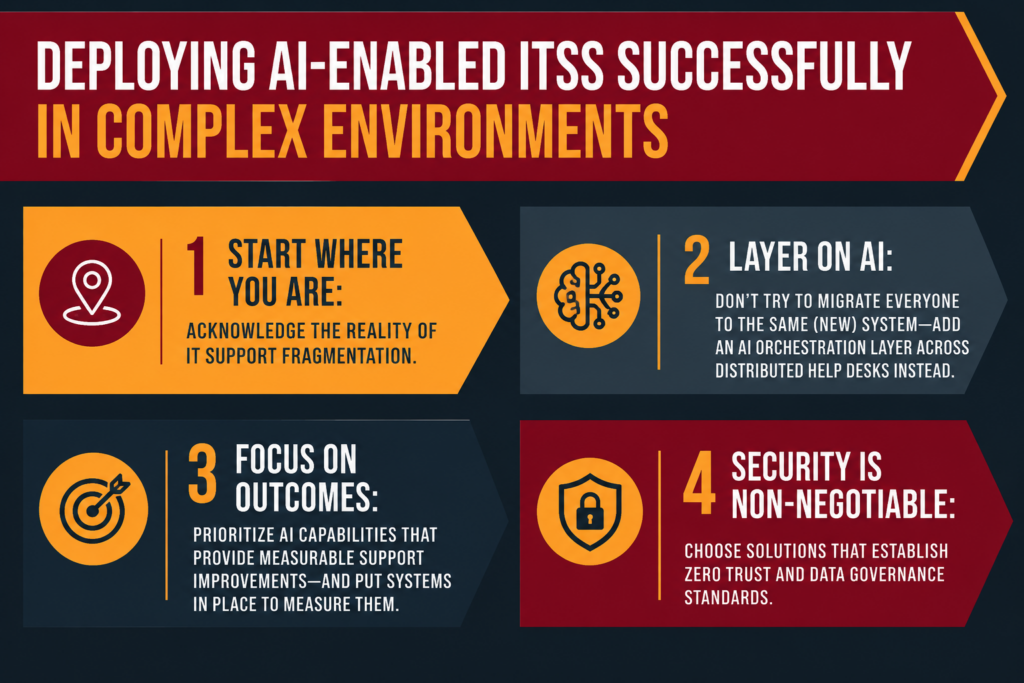
Asking teams and programs to change tools or overhaul workflows just to adopt an AI solution is disruptive and unrealistic. People have invested years in current systems and processes; they don’t want to learn an entirely new system just to submit a level-one ticket.
The key is AI-enabled ITSS that sits on top of what you already have, rather than replacing it. In practice, that means an orchestration layer that:
The goal is to extract more value and capability from existing platforms, rather than forcing teams to learn something new altogether.
Many major IT service management (ITSM) platforms, like ServiceNow or Jira, now offer AI features. The catch is that those capabilities are usually locked inside that one ecosystem. In a complex environment, where you may already have multiple help desks, specialized applications, and long-standing contracts, that vendor lock-in becomes a liability.
Our view is that AI-enabled ITSS should be technology-agnostic. The AI layer should:
In other words, the “brain” of your AI-enabled ITSS should not live only inside one vendor’s ticketing product. Its independence is important because that allows it to carry your existing knowledge bases forward and follow your environment as it evolves.
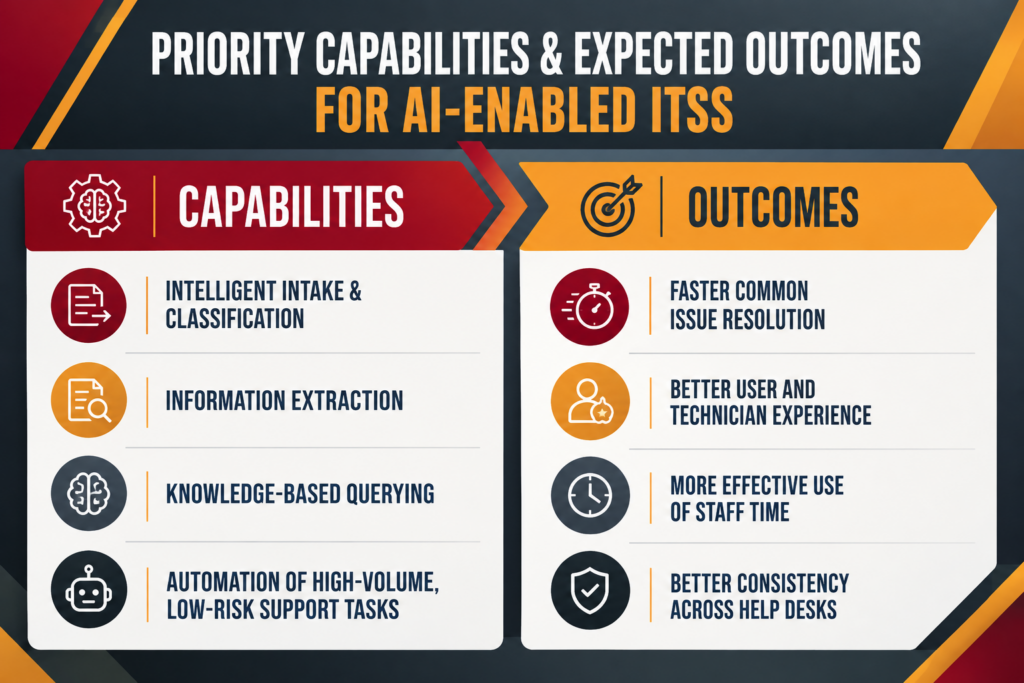
For us, AI-enabled ITSS isn’t just a chatbot in front of a ticket queue. The value comes from practical capabilities that improve support in multiple ways, including:
There’s no question that AI can be transformational in automating support, but doing so with security and compliance is non-negotiable for federal environments.
For this reason, any AI-enabled ITSS initiative must be designed with Zero Trust Architecture principles in mind. The AI orchestration layer should:
Governance is just as important. Certain actions—like sensitive access changes and non‑reversible updates—shouldn’t be fully automated. In those situations, AI can gather context and recommend next steps, but a manager or approver still confirms the action. This human-in-the-loop QC preserves both speed and accountability.
We also don’t assume an existing ITSM authority to operate (ATO) automatically covers a new AI layer. In many cases it will need its own ATO and a clear description of what it can see and do. A practical approach is to start with low‑risk, narrow‑scope use cases (read‑only, no PII) and expand as trust grows.
“In a complex environment, where you may already have multiple help desks, specialized applications, and long-standing contracts, vendor lock-in becomes a liability. Staying technology-agnostic is key.”
Abhijeet Balsaraf, DevOps Manager, CTIS
For us, the point of AI-enabled ITSS is not the technology itself, but the outcomes it enables in complex federal environments. When you add an AI orchestration layer on top of existing help desks and applications, you should expect to see faster resolution for common issues; better experience for users and technicians; more effective use of staff time; and greater consistency across programs and tools.
Measuring these improvements will tell you whether AI-enabled ITSS is actually helping you deliver on your mission, not just adding another system to manage. The agencies that see measurable outcomes are likely choosing technology-agnostic solutions that orchestrate intelligently across existing tools, respect zero trust, and prioritize practical support improvements. That’s the standard we design for, and the lens we recommend you use when you evaluate any AI-enabled ITSS offering.
Discover how CTIS is building an AI-enabled ITSS proof of concept and learn more about the full suite of Health IT capabilities. As we move toward the next standard of ITSS, contact us to be part of the conversation around requirements and capabilities for your complex support environments.
Today, most RFPs for federal ITSS solutions describe a tidy, single-tool help desk environment—but the reality of many federal support desks is much messier. Multiple help desks and platforms are often used across agencies, from ServiceNow to Vivantio and application-specific help desks. These are often siloed and fragmented, without any centralized coordination or interoperability.
But end users don’t think in terms of which tool owns their ticket; they just need their issue resolved quickly and securely so they can do their jobs. So, for any AI‑enabled ITSS approach to succeed, it must start from your actual environment: multiple platforms, legacy applications, fragmented processes, and strict security boundaries. Any ITSS vision that assumes everything lives in one tool or that you’ll “just migrate” to a new platform to make AI work ignores the reality of how federal operations really function.