Over three decades of working with clinical trials, including more than 25 years supporting NCI’s Cancer Therapy Evaluation Program (CTEP), CTIS has had a front-row seat to the research behind promising new therapies. This has also given us a clear view of the roadblocks often encountered across trial sponsors, sites, and government agencies. In many cases, the biggest limiting factor in the pace of clinical progress is the data—specifically, the platforms used to manage and share it.
We see the same challenges again and again:
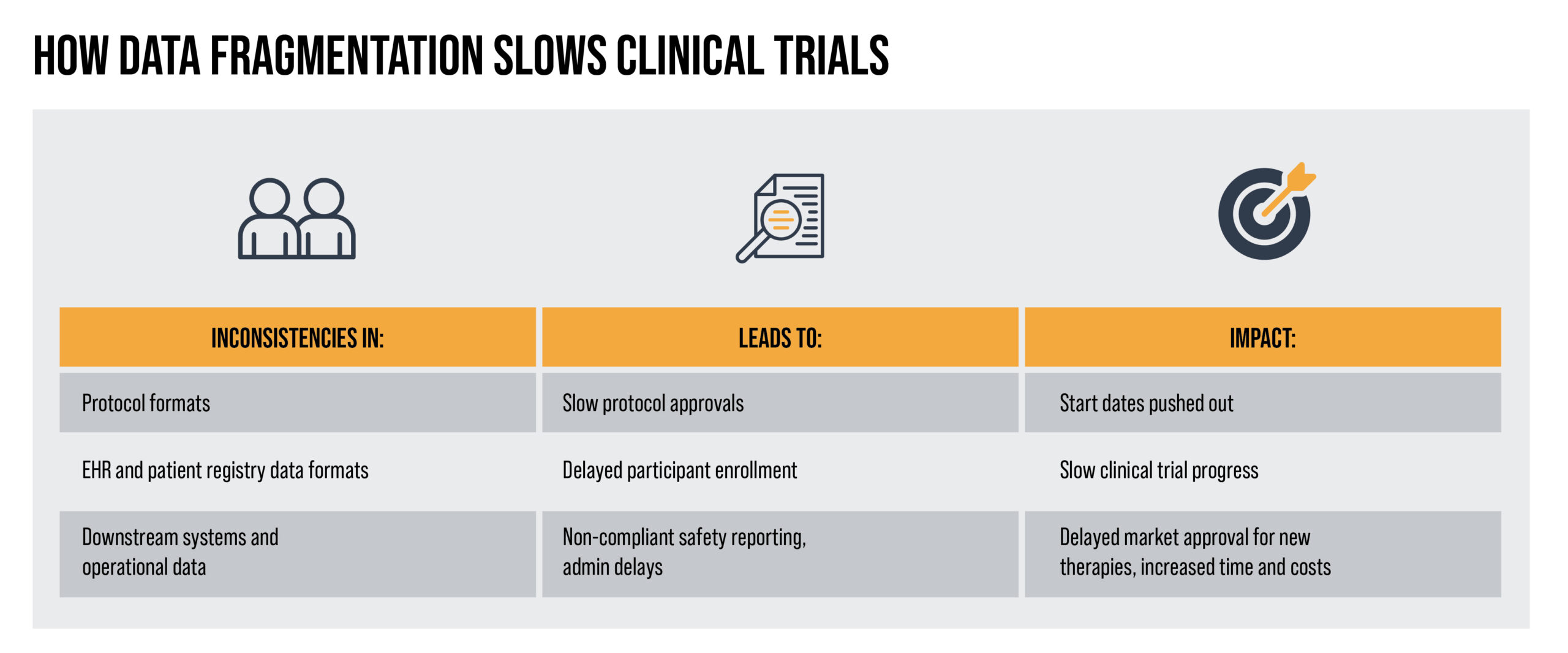
These create a series of bottlenecks: Protocol approvals take longer. Trials take longer to get started. Patient accrual slows. Safety reporting and regulatory submissions become tedious, time consuming, and expensive. Fortunately, progress is happening with the Clinical Data Interchange Standards Consortium (CDISC) and the Fast Healthcare Interoperability Resources (FHIR) standard to improve clinical data sharing across agencies and with clinical trial organizations, but it’s important to consider the practical limitations. Today, most clinical trial sponsors and cooperative groups still have their own way of writing protocols and structuring systems. Even when standards are fully adopted, a larger problem exists: the standards themselves evolve continuously. By the time you’ve fully migrated to them, they’ve often changed again.
In this article, I walk through where data sharing bottlenecks show up in the clinical trial lifecycle and how we at CTIS are thinking about “live” platforms for real-time data interoperability—bridging different data standards and protocol versions as they shift. This capability would in turn help minimize delays in data sharing due to standard compliance issues and help address the trial bottlenecks that slow the pace of clinical research.
In clinical research, everything starts with the protocol, which often includes hundreds of pages of information necessary to running the trial. Our experience has shown that in many cases each protocol arrives in very different shape. A “primary objective” in one might be a “target objective” in another. Participant eligibility, consent, and demographics are often documented inconsistently.
The problem is, the protocol has to be approved before the trial can even begin and as the start date gets pushed out, research is further delayed. Reviewers are burdened interpreting each sponsor’s format and finding and entering key elements. It’s not uncommon for this to consume many months. Meanwhile, the trial schedule falls behind.
At CTIS, we look at this challenge as one best solved with a live or real-time interoperability platform. Instead of trying to keep up with shifting protocol templates and standards, this platform continuously learns and maps protocol language to a standard model aligned with cross-agency standards including CDISC and FHIR.
Data fragmentation can also slow down operations once clinical trials have begun, and in finding and enrolling participants. Eligibility criteria are often written differently from one protocol to the next, and patient data is pulled from many different sources like electronic health records (EHRs) and participant registries that all have their own structure. Unless each repository understands the same structure of what the sponsor’s requirements are for the trial, there will be delays in manually sifting through them and finding the right patients to match the enrollment criteria. This can be especially burdensome for cancer clinical trials where criteria can be complex and time windows are tight.
A third bottleneck shows up as clinical trial data is collected and shared with downstream systems, like those used for safety reporting or submitting regulatory documentation. When data is represented in one format, it can only be exported to those systems in that format. The issue arises when the downstream system has a different way of representing the data. If the source system or the destination system has changed their specifications, the entire link is broken. This is the biggest hurdle right now to timely safety and compliance reporting for clinical trials.
A key example: adverse event reporting to the Food and Drug Administration (FDA). For years, the FDA required Individual Case Safety Reports (ICSRs) in the E2B (R2) data format. When they set a deadline for transitioning to E2B (R3), many small trial organizations were not ready to collect and transmit R3 data natively, so we built a tool to seamlessly convert R2 to R3 data for them. This conversion is very valuable, but it’s a never-ending cycle without a continuously updating data platform. Each time a new data format or cross-agency data standard requirement is released, clinical trial organizations must manually migrate or find bridge solutions.
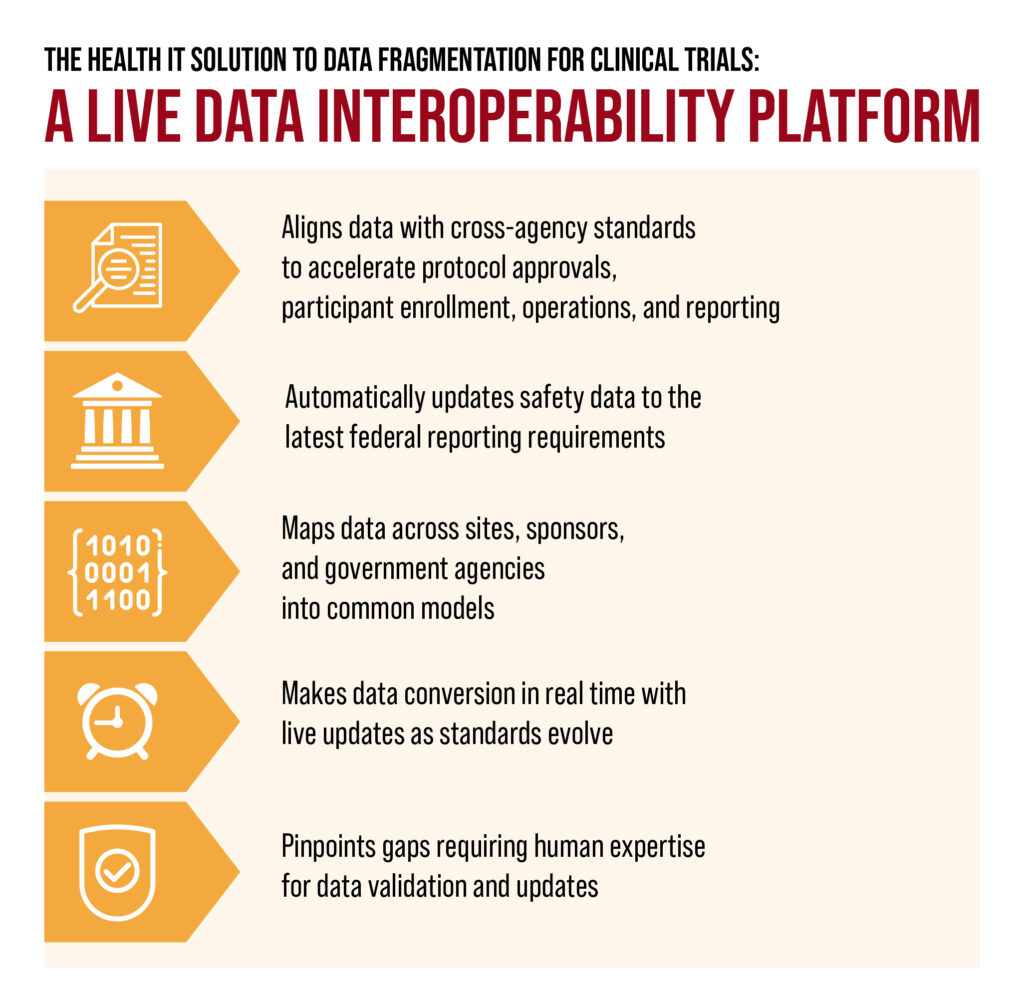
A live platform for interoperable data helps to make these types of conversions continuous. Instead of building a separate bridge for each change, it generalizes conversion tasks to apply to any changes in data standards or formats on an ongoing basis. This allows sponsors and agencies to reduce rejections based on non-compliant formats, minimize rework, and keep safety and regulatory processes moving, even when standard specifications are changing frequently.
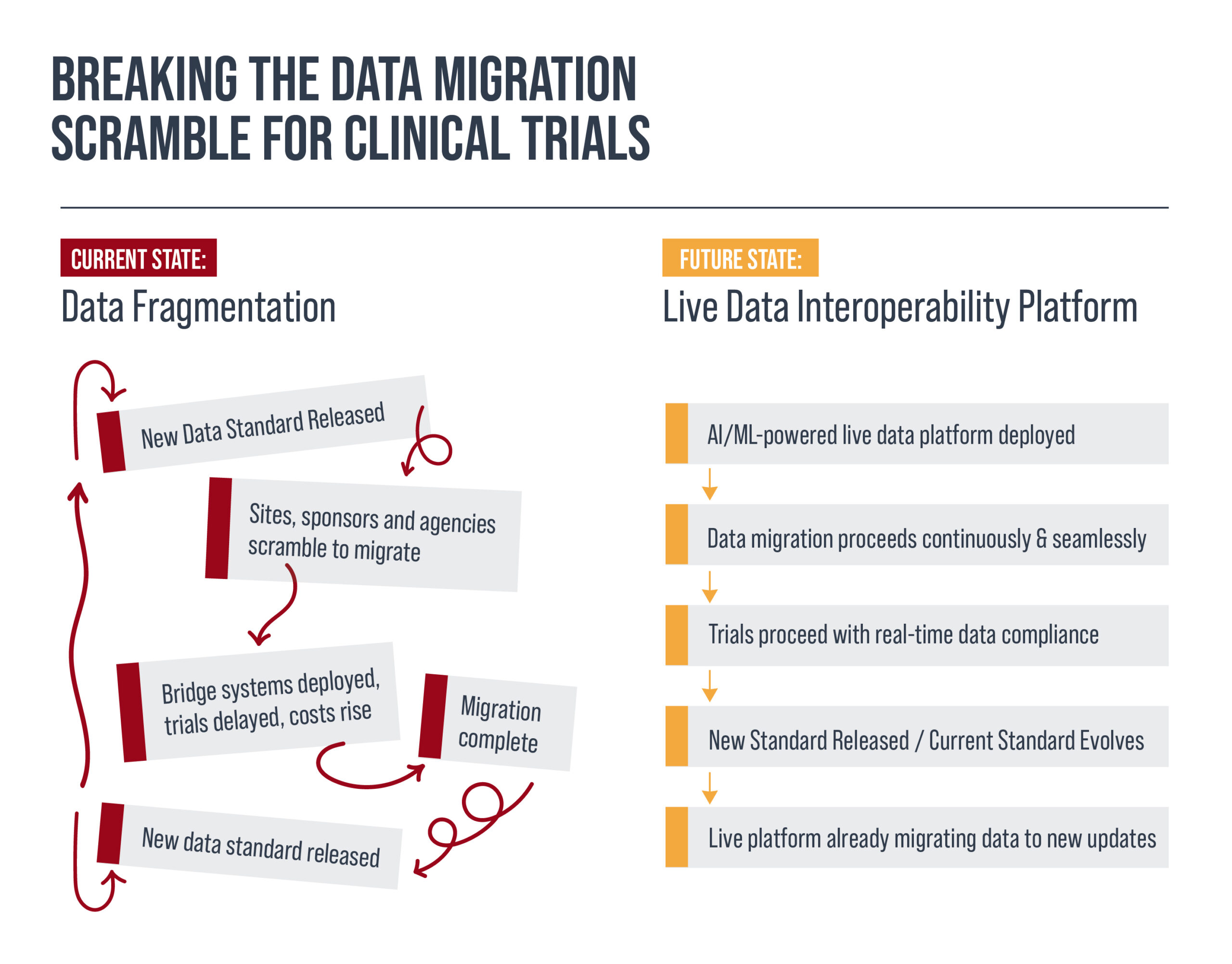
Across all of the bottlenecks we’ve discussed, the pattern is the same. Clinical trials are often hamstrung by differing data formats, standards, and versions across collection, submission, and processing by downstream systems and the continuous evolution of the standards themselves. We’ve seen clearly that today’s standards are not tomorrow’s, so we cannot treat data interoperability as a one-time compliance task.
A more sustainable approach and capability is leveraging an AI/ML-powered live platform for continuously evolving data interoperability that:
CTIS’s years of experience with clinical trials provides a foundation for these capabilities alongside deep subject matter expertise to validate and maintain them over time for continuous quality assurance. It’s important to note that the goal here is not to eliminate data standards, but to ensure that as they evolve, the clinical trial ecosystem is not constantly delayed by systems at differing stages of migration to the most recent standard or format. Ultimately, this is how we can ensure data interoperability in real time, fewer data sharing delays across agencies and trial sponsors, and expedite clinical trials to get promising therapies approved faster.
Learn more about CTIS’s health IT capabilities.